



New - 2 Hours Ago
Pros and Cons of Living in Dallas TX
By Jeffrey Knox, Broker / Owner, Knox & Associates
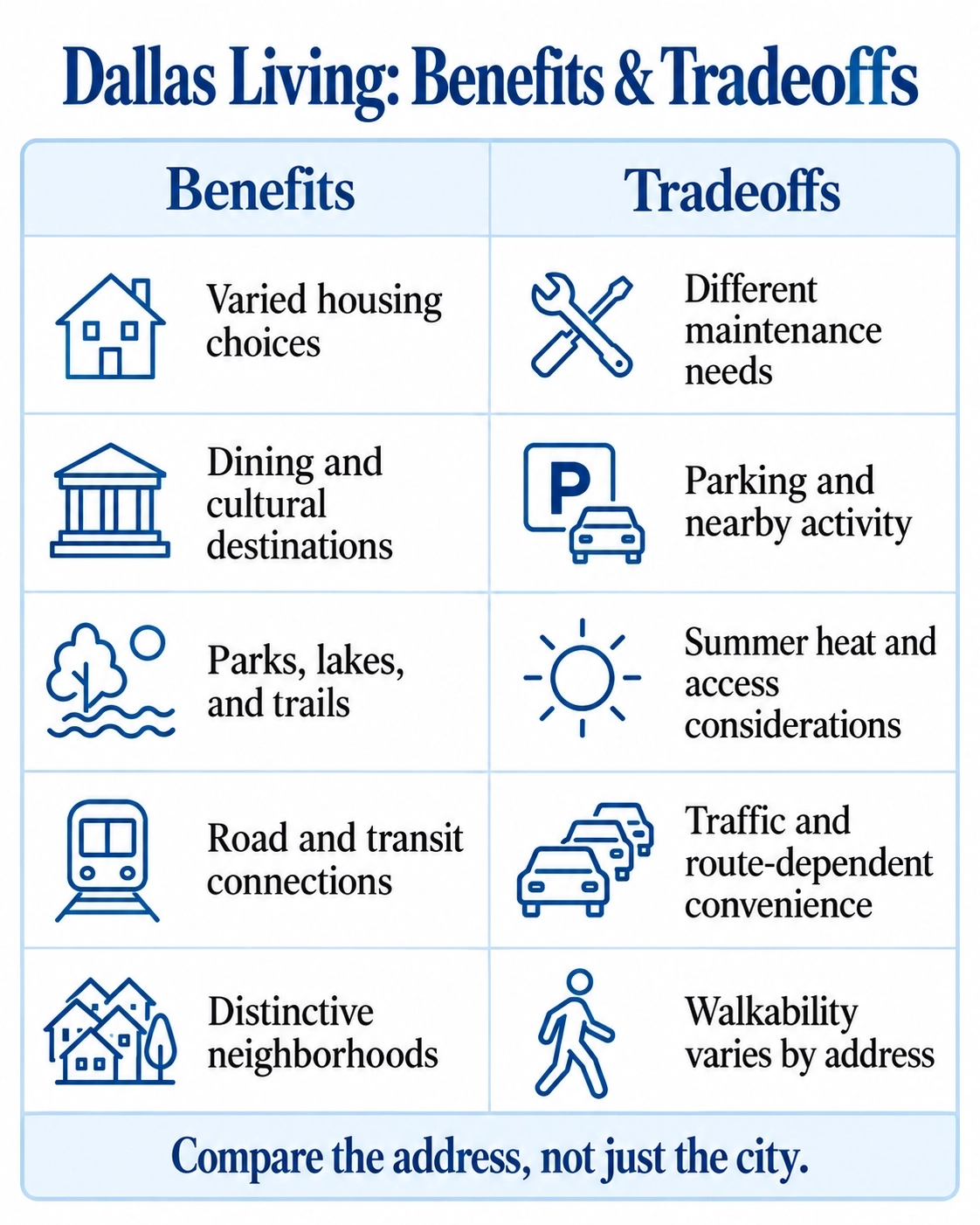
Living in Dallas offers a broad choice of homes, distinctive neighborhoods, restaurants, cultural attractions, parks, and regional travel connections. The tradeoffs include hot summers, traffic, uneven walkability, and housing expenses that extend beyond the purchase price or monthly rent.
For buyers exploring Dallas TX Homes for Sale, the most useful question is how a particular address fits their daily routine. A downtown condo, an East Dallas bungalow, and a North Dallas custom home can offer very different experiences within the same city.
Dallas can be a strong fit when you choose the location and property carefully. This guide compares the advantages and disadvantages, explains the practical implications, and helps you build a more focused home search.
Pros and Cons of Living in Dallas at a Glance
| Factor | Advantage | Tradeoff | What to Compare |
|---|---|---|---|
| Housing | Condos, townhomes, established houses, and custom homes | Size, condition, and maintenance vary widely | Usable space and total ownership cost |
| Neighborhoods | Distinctive architecture and settings | A neighborhood name does not describe every block | The specific street and property |
| Transportation | Highway connections and public transit options | Traffic and transfers can complicate trips | Actual routes at your usual travel times |
| Outdoor recreation | Lakes, parks, and trails | Heat and access routes affect everyday use | Shade and practical park or trail access |
| Dining and culture | Restaurants, museums, and performance venues | Parking, crowds, and travel time vary | Proximity to places you regularly visit |
| Weather | Opportunities for outdoor activities in multiple seasons | Summer heat and severe-weather exposure | Cooling, shade, roof condition, and drainage |
| Taxes and expenses | No Texas personal income tax | Other taxes and property expenses still apply | A complete household budget |
| Walkability | Some areas support walking to daily destinations | Convenience changes from block to block | Sidewalks, crossings, and errand routes |
The Pros of Living in Dallas
1. A Wide Range of Housing Choices
Dallas provides several ways to approach homeownership. Buyers can compare high-rise residences, townhomes, traditional detached homes, historic architecture, contemporary construction, and custom estates.
Those options allow the search to begin with how you want to live:
- A condo may reduce some direct exterior maintenance responsibilities.
- A townhome may combine multiple living levels with a smaller private lot.
- An established detached home may offer mature landscaping and architectural character.
- A custom residence may provide specialized spaces and more extensive outdoor living.
Buyers considering Dallas Condos for Sale should compare the residence and building together. Parking, storage, dues, reserves, and association rules can influence the decision as much as views or finishes.
For detached homes, focus on the relationship between interior space, lot usability, and ongoing maintenance.
2. Neighborhoods With Distinctive Architecture and Settings
Dallas offers meaningful differences between neighborhoods.
Lakewood Homes for Sale and nearby East Dallas properties provide options for buyers exploring established architecture and the White Rock Lake area. Kessler Park Real Estate offers another setting to compare when terrain and architectural individuality matter.
For an urban condo or townhome search, Uptown Dallas Properties and Victory Park Condos provide different relationships to restaurants, entertainment, and downtown destinations.
Buyers seeking substantial detached residences can explore Preston Hollow Homes alongside other North Dallas options.
The advantage is choice. The important step is turning that choice into a shortlist based on the property features and locations you will actually use.
3. Parks, Lakes, and Trails
Dallas offers outdoor destinations ranging from neighborhood parks to White Rock Lake and its surrounding trails. The Katy Trail and other trail corridors add opportunities to incorporate walking, running, and cycling into everyday life.
For buyers comparing White Rock Lake-Area Homes, practical access matters more than a broad proximity claim. Identify the entrance you would use, how you would reach it, and whether the route suits your preferred activity.
A property near a trail may still require a drive or an inconvenient crossing. Another home farther away may have a more straightforward route.
Look for the combination that works for you: useful outdoor destinations, manageable access, and private outdoor space that fits your routine.
4. Dining, Arts, and Entertainment
Dallas supports a varied mix of restaurants, museums, galleries, and performance venues. The Arts District brings major cultural destinations together, while areas such as Deep Ellum, Bishop Arts, and Lower Greenville offer different dining and entertainment settings.
Living close to places you visit regularly can make those destinations easier to enjoy. That benefit depends on the specific property, parking arrangements, and route.
Buyers exploring Dallas Arts District Condos should compare convenient access with building characteristics, views, and ownership expenses. For homes near active dining corridors, visit when nearby businesses are busiest.
5. Regional Travel Connections
Dallas Love Field is within the city, while DFW International Airport provides another major regional travel option.
Frequent travelers should compare both airports against their usual trips. The relevant question is the route from the property to the airport you expect to use, rather than a general claim that a neighborhood is close to air travel.
Evaluate typical departure times, transportation choices, and parking needs. Also assess aircraft noise at the individual property if airport proximity is part of your search.
6. No Texas Personal Income Tax
Texas does not impose a personal income tax, which is a meaningful budgeting consideration for people relocating from states that do.
However, evaluate the complete financial picture. Property taxes, sales taxes, insurance, transportation, utilities, and housing costs still affect your expenses.
For a home purchase, use address-specific information and current quotes. A seller’s existing tax bill or insurance premium may not reflect your future costs.
The Cons of Living in Dallas
1. Traffic Can Shape Your Daily Routine
Dallas has extensive road connections, but access to a highway does not guarantee a straightforward commute.
A short distance can involve congested interchanges, difficult turns, or a route that behaves differently during peak travel periods. Regular cross-city trips can make location a decisive part of the home search.
Before choosing a property, test the trips you expect to make most often:
- Work or other recurring destinations.
- Grocery stores and everyday services.
- Parks, trails, and recreation.
- Airport departures.
- Regular evening activities.
Evaluate both directions. A manageable morning trip does not necessarily predict the return journey.
2. Car-Free Convenience Is Address-Specific
DART provides rail, bus, and other transit services, but usefulness depends on the trip. Station proximity alone does not tell you the walking route, number of transfers, or total travel time.
The same applies to walkability. A home can be near restaurants while still requiring a vehicle for groceries or other regular errands.
Walk the actual routes. Check sidewalk continuity, street crossings, shade, and entrances to the businesses you expect to use.
If reducing driving is a priority, make that a property-level requirement from the beginning.
3. Summer Heat Affects Outdoor Living
Dallas summers can be hot, influencing how you use patios, balconies, trails, and yards.
Outdoor square footage is more valuable when it is comfortable during the hours you intend to use it. A covered terrace or shaded seating area may function differently from a large exposed patio.
During a showing, consider:
- Afternoon sun exposure.
- Existing shade and covered areas.
- Window orientation.
- Cooling-system condition.
- Irrigation and landscape requirements.
- The placement of outdoor seating or a pool.
For condo buyers, evaluate terrace exposure and whether building rules permit the shading arrangements you want.
4. Weather Adds Property Considerations
North Texas experiences thunderstorms and severe weather, with the frequency of thunderstorms and associated severe weather typically peaking in spring.
For buyers, the practical task is understanding the property’s condition and exposure. Roof age, drainage, tree placement, windows, and documented repairs deserve attention.
Ask about prior water intrusion and review relevant disclosures and inspections. For properties near creeks or low-lying areas, examine flood information and the survey rather than relying on appearance.
5. Housing Costs Extend Beyond the Asking Price
A purchase price does not reveal the full cost of living in a home.
Two properties with similar prices may differ substantially in taxes, insurance, utilities, HOA dues, maintenance, and repair needs. A larger house may also require more cooling, upkeep, and furnishings.
Use the same budget categories for each property:
| Expense | What to Review |
|---|---|
| Housing payment | Your financing terms or lease terms |
| Property taxes | Current address-specific information and applicable exemptions |
| Insurance | A quote for the property and intended coverage |
| HOA or condo dues | Current assessments, included services, and planned changes |
| Utilities | Available usage history and the home’s condition |
| Maintenance | Roof, systems, landscaping, pool, and exterior needs |
| Transportation | Fuel, tolls, parking, or transit costs for regular trips |
Dallas should not be treated as uniformly inexpensive. The relevant comparison is the total cost of the home and location you are considering.
6. Established Homes Can Require More Due Diligence
An established house may offer character, mature trees, and a location you prefer. It can also require closer evaluation of systems, structural conditions, drainage, and prior renovations.
Distinguish attractive finishes from documented improvements. A new kitchen does not establish the condition of plumbing, wiring, roofing, or mechanical equipment.
Review permits where relevant, obtain appropriate inspections, and investigate recommendations for further evaluation. Compare the home’s current function with the changes you expect to make.
7. Urban Activity Can Affect the Property Experience
Proximity to restaurants, venues, and major roads can be convenient. It can also bring activity, parking pressure, lighting, or noise that varies throughout the day.
Visit the property during the periods that matter to you. Evaluate the bedroom orientation, windows, balcony or backyard, and nearby sources of activity.
The goal is to understand the setting before making a decision.
Dallas City Limits Versus the Greater Dallas Area
A relocation search described as “Dallas” may include surrounding municipalities with different locations, services, and property characteristics.
Highland Park and University Park are separate municipalities. Plano, Richardson, Irving, Frisco, and other nearby cities also should be evaluated individually rather than treated as Dallas neighborhoods.
Keep the search tied to actual addresses. City names, mailing addresses, association boundaries, and service areas do not always answer the same question.
How to Choose a Dallas Neighborhood for Your Priorities
| Your Priority | Areas to Begin Comparing | What to Verify |
|---|---|---|
| Urban condos and townhomes | Uptown, Downtown, Victory Park, Turtle Creek | Parking, building expenses, and daily walking routes |
| White Rock Lake-area recreation | Lakewood, Forest Hills, Little Forest Hills | Actual lake access and the individual home’s condition |
| Substantial detached homes | Preston Hollow and North Dallas | Usable lot space and maintenance requirements |
| Architectural individuality | Bluffview, Kessler Park, M Streets | Site conditions, renovations, and property layout |
| Gated-community options | Glen Abbey, Glen Lakes, Lake Forest | Assessments, access procedures, and included services |
| Dining destinations nearby | Lower Greenville, Bishop Arts, Deep Ellum | Walking routes, parking, and nearby activity |
These are starting points. Compare the specific property and street before deciding that an entire neighborhood fits your needs.
Before You Move to Dallas
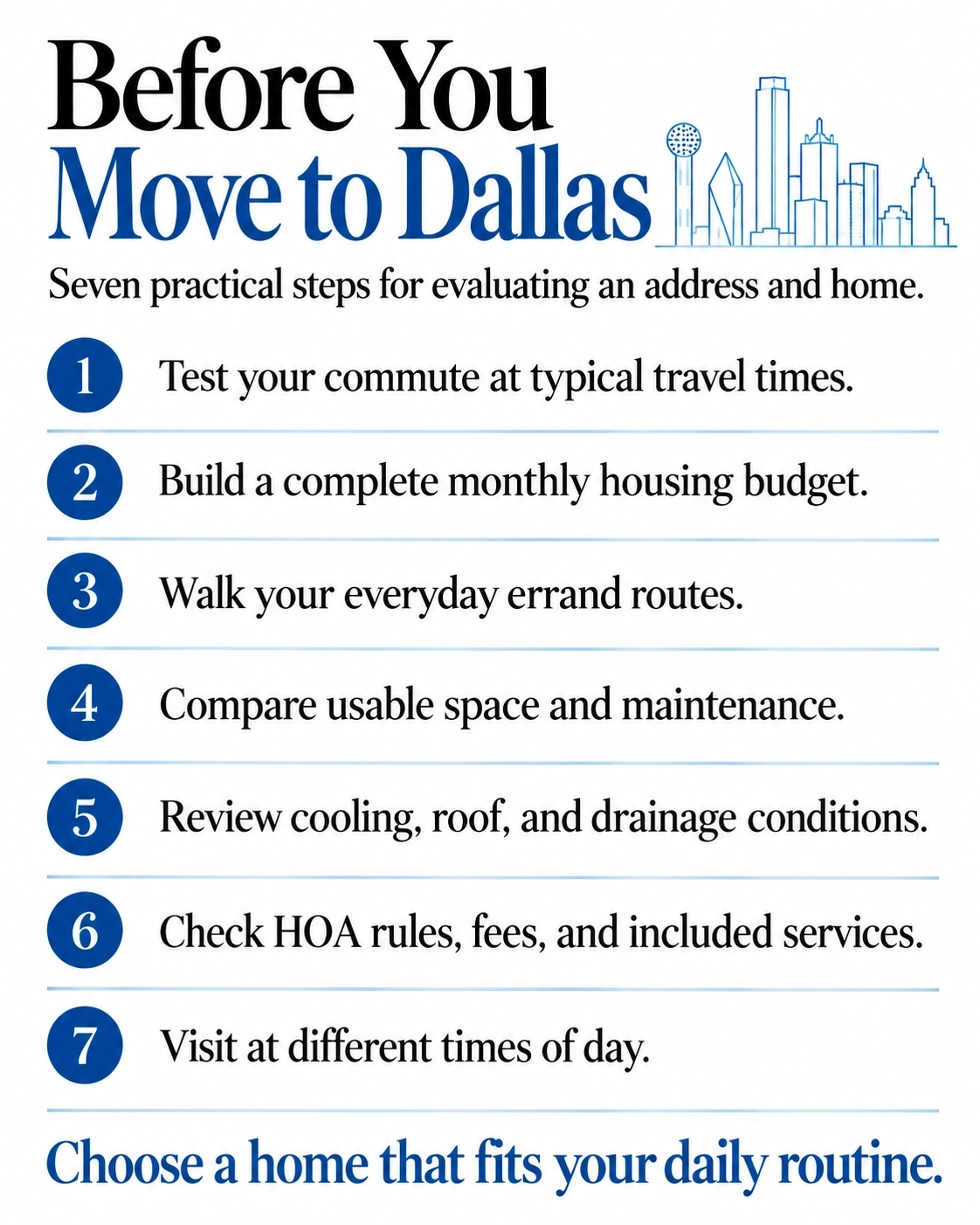
A focused search begins with seven practical steps:
- Test your commute at typical travel times.
- Build a complete monthly housing budget.
- Walk your everyday errand routes.
- Compare usable space and maintenance.
- Review cooling, roof, and drainage conditions.
- Check applicable HOA rules, fees, and included services.
- Visit at different times of day.
For buyers considering higher-end properties, Dallas Luxury Neighborhoods, Dallas Gated Communities, and Dallas High-Rise Condo Buildings provide additional ways to organize the search.
Frequently Asked Questions About Living in Dallas
Is Dallas a Good Place to Live?
Dallas can be a good fit for people who value varied housing choices, restaurants, cultural destinations, and regional travel connections. The decision depends on how well a specific home accommodates your budget, transportation needs, and daily activities.
What Are the Biggest Drawbacks of Living in Dallas?
Common practical tradeoffs include summer heat, traffic, uneven walkability, and ownership expenses beyond the mortgage payment. Property condition and the specific location can make those tradeoffs more or less significant.
Can You Live in Dallas Without a Car?
It can be workable for some addresses and routines, especially when daily destinations align with walking and transit routes. Test the complete trips you expect to make, including errands and evening travel, before selecting a property.
Is Living in Dallas Affordable?
Affordability depends on the property and your household budget. Compare housing payments, taxes, insurance, utilities, maintenance, association dues, and transportation expenses rather than relying on a citywide label.
Local Expert Perspective
With more than 20 years of residential real estate experience and hundreds of successful transactions, Jeffrey Knox helps buyers connect neighborhood choices with practical property decisions.
Three questions keep a Dallas search focused: Does the layout support your routine? Does the location work for your regular trips? Can you comfortably manage the complete ownership cost?
The strongest choice answers all three. Extra square footage, a recognizable neighborhood name, or an attractive finish should be considered alongside those fundamentals.
Why Buyers Choose Knox & Associates
Knox & Associates provides neighborhood-first guidance for Dallas buyers and relocation clients.
Our Dallas Real Estate Agents help you compare locations, evaluate homes and comparable sales, coordinate inspections, and understand property-specific considerations before closing.
Whether you prefer a condo, townhome, established house, or custom residence, we help turn a broad search into a manageable set of options.
Find a Dallas Home That Fits Your Daily Life
Explore Homes for Sale in Dallas and compare properties based on the advantages that matter most to you.
Knox & Associates can help you evaluate the home, its location, and the practical tradeoffs of living there.
Call (972) 342-0000